Week Notes: Vol. 2 – № 14
20 books I read in 2025
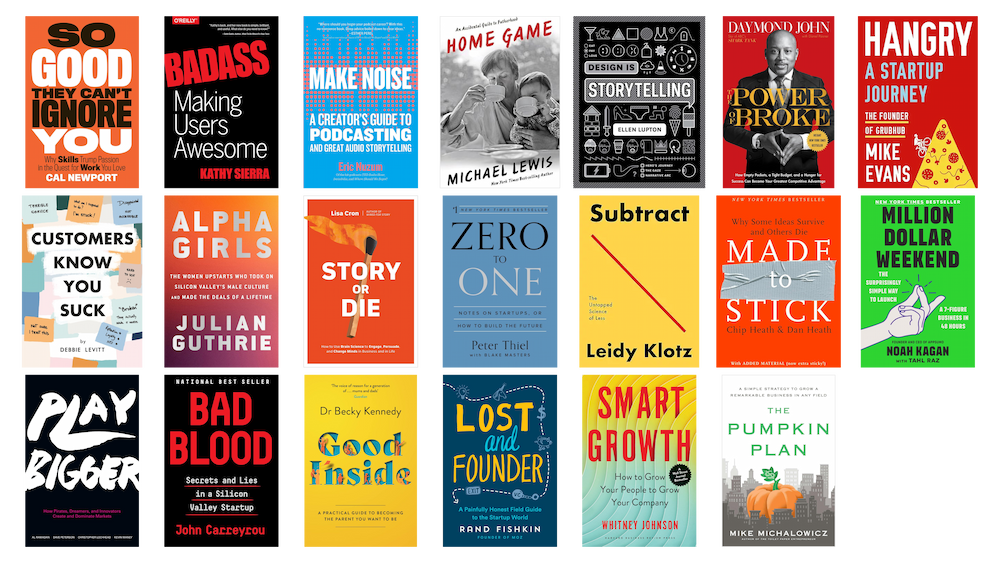
I read 20 books in 2025. It's the most I've ever read in a single year. A few books about design. A couple on parenting.
The defining theme of 2025 was finding your personal advantage: building career capital, creating categories, differentiating, and using constraints as fuel in a year where certainty was scarce and your edge mattered most.
Browse the list below to jump to a specific review. Or skip right to my favorites.
- Favorites of the year
- "Hangry: A Startup Journey" by Mike Evans
- "Bad Blood: Secrets and Lies in a Silicon Valley Startup" by John Carreyrou
- "Good Inside: A Practical Guide to Resilient Parenting Prioritizing Connection Over Correction" by Becky Kennedy
- "So Good They Can't Ignore You" by Cal Newport
- "Made to Stick: Why Some Ideas Survive and Others Die" by Chip Heath & Dan Heath
- Worth a read
- "Alpha Girls: The Women Upstarts Who Took On Silicon Valley's Male Culture and Made the Deals of a Lifetime" by Julian Guthrie
- "Lost and Founder: A Painfully Honest Field Guide to the Startup World" by Rand Fishkin
- "Million Dollar Weekend: The Surprisingly Simple Way to Launch a 7-Figure Business" by Noah Kagan
- "The Power of Broke: How Empty Pockets, a Tight Budget, and a Hunger for Success Can Become Your Greatest Competitive" by Daymond John
- "Make Noise: A Creator's Guide to Podcasting and Great Audio Storytelling" by Eric Nuzum
- "Home Game: An Accidental Guide to Fatherhood" by Michael Lewis
- "Play Bigger: How Pirates, Dreamers, and Innovators Create and Dominate Markets" by Al Ramadan, Dave Peterson, Christopher Lochhead, and Kevin Maney
- "Customers Know You Suck: Actionable CX Strategies to Better Understand, Attract, and Retain Customers" by Debbie Levitt
- "The Pumpkin Plan: A Simple Strategy to Grow a Remarkable Business in Any Field" by Mike Michalowicz
- Not what I hoped for
- "Design Is Storytelling" by Ellen Lupton
- "Zero to One: Notes on Startups, or How to Build the Future" by Peter Thiel and Blake Masters
- "Badass: Making Users Awesome" by Kathy Sierra
- "Story or Die: How to Use Brain Science to Engage, Persuade, and Change Minds in Business and in Life" by Lisa Cron
- "Subtract: The Untapped Science of Less" by Leidy Klotz
- "Smart Growth: How to Grow Your People to Grow Your Company" by Whitney Johnson
Favorites of the year
"Hangry: A Startup Journey" by Mike Evans
Rating: 5 out of 5
From the first chapter I knew I would love this book.
Either Mike Evans, the founder of GrubHub, missed a calling as a writer, or he hired one hell of a ghostwriter.
"Hangry" is very approachable, given that it’s a bit of an origin-story of a high-wealth individual. I enjoyed all the details about the early days of GrubHub—trying, failing, struggling.
I also appreciated Mike’s self awareness, for example, contrasting his feelings about board dinners and schmoozing with his bike ride across America.
This is a story worth reading.
"Bad Blood: Secrets and Lies in a Silicon Valley Startup" by John Carreyrou
Rating: 5 out of 5
Holy cow! There's a reason why this book is a bestseller and reviewers describe it as "unputdownable."
From the first few pages you understand that things began wrong at Theranos. But as the stakes get higher and praises are sung, the lies get more elaborate. Carreyrou keeps you wondering when Elizabeth Holmes finally gets caught, but each time reveals how Holmes was able to assemble a nearly impenetrable defense and keep her "business" insulated. At times you feel sorry for Holmes. Other times (most of the time) you are left in disbelief that someone could do any of this.
Carreyrou puts on a clinic when it comes to one-line, page-turning cliffhangers. Never did I realize that such simple sentences could force my hand to turn to the next page.
Very well crafted and carefully explained – everything from the science to the process of piecing together the story. You don't need to know anything about Silicon Valley, hematology, or business to enjoy this disturbing fall from grace.
"Good Inside: A Practical Guide to Resilient Parenting Prioritizing Connection Over Correction" by Becky Kennedy
Rating: 4.5 out of 5
A must-read for any parent.
As Dr. Becky even says in the first portion of this book, these strategies are also transferrable to relationships with friends and the workplace.
Biggest takeaways:
-
Connection: I learned that younger children are afraid to be alone with their emotions. This makes sense that my experiences with time outs have escalated tantrums. As much as I didn't like the idea of being with my kid during a timeout, Dr. Becky also provides tactics for giving yourself a break when you are overwhelmed and overstimulated when you need to give a timeout.
-
"Bad" inside: Because kids are scared of their emotions, they are prone to misinterpreting them and think they themselves are bad. As parents we're sometimes not as careful with our words as we ought to be. Dr. Becky relates how we might have been treated by our parents as a kid can enforce a mindset of shame and guilt which will lead kids to develop the opposite behavior you want them to have as they grow up.
-
Two things are true: This is applicable to everyday life but rarely are things binary. We tend to think "either or" instead of "and" which gets us into trouble. For parents "two things being true" means acknowledging that your child is upset about bedtime but also being firm that it's time for bed. dealing with this looks like letting your child know that it's OK to be upset, and that they're feelings are justified. But you as a parent are holding your ground in what the situation requires.
"So Good They Can't Ignore You" by Cal Newport
Rating: 4 out of 5
"So Good They Can’t Ignore You" is based on a Steve Martin quote. The gist is that you have to build career capital before you can earn more flexibility, responsibility, or the ability to adapt your experience across fields or industries.
I especially liked the distinction the book makes between people who quit their jobs to do something completely different—and often fail—and those who make what looks like a big leap but is actually a natural next step in their larger journey.
That idea resonated with me. When people say they can see the thread connecting my first job to where I am now, it’s because I’ve been building and using career capital all along, even if I didn’t realize it at the time.
Funny enough, Steve Martin has been popping up in my life over the past few years—maybe that’s not a coincidence.
"Made to Stick: Why Some Ideas Survive and Others Die" by Chip Heath & Dan Heath
Rating: 5 out of 5
This is the second time I read this book. I wanted to make sure it was as good as I remembered.
This was the first book I read when trying to become a better storyteller. That was 2019, and I've read many since then.
"Made to Stick" is a bit different. It lightly touches on structure. But it gives you some basic elements, and I like how it preaches that even if you employ one of the tactics in their SUCCESs framework, you will be doing a better job than most.
I think it's a good starting point for many because it's wide and modestly deep.
In reading this again I realized how much of this approach is a large part of my communication ethos. I'd like to think much of this book “stuck” with me.
I think what enamored me when I first read this was the reference to the inverted pyramid, as well as localizing information and zooming in or out from data.
These concepts were familiar to me from my college journalism courses and helped me reconnect my knowledge. I know these concepts may be entirely new to some, so supplemental reading will be required.
I've read 3 books by the Heath brothers. I think this and "Switch" are my favorites. Decisive is excellent too but a bit niche.
I just enjoy how they structure books. There are bite-sized chunks that make it easy to read and get small nuggets.
Worth a read
"Alpha Girls: The Women Upstarts Who Took On Silicon Valley's Male Culture and Made the Deals of a Lifetime" by Julian Guthrie
Rating: 4 out of 5
"Alpha Girls" grew on me. At first I wasn't sure if the split narratives would make it hard to follow and keep track.
That wasn't the case. Each "character" is distinct with a clear story. While this is a book about wealthy venture capitalists, the author really focuses on their personal lives and journey.
Sure, there is some talk about sexy investments and founding of iconic tech companies. But this book is really about struggle, loss, and rebirth.
It is sad (and at times disgusting) to read about the misogyny and realities women faced in the workplace – much of which continues today.
Some things I couldn't fathom any human consciously thinking he could do or say and also expect to get away with.
A big reality check for the naive.
"Lost and Founder: A Painfully Honest Field Guide to the Startup World" by Rand Fishkin
Rating: 4 out of 5
A very good look into the world of a company, Moz, I am very familiar with. A mix of facts and narrative.
I would recommend this to any tech founder. But it's worth any entrepreneur's time given the wide range of concepts covered.
Honestly the most compelling thing is Rand's honesty about how wealthy (or not so much) he is because of Moz.
He really puts the "rich founder" narrative to bed quickly. In fact, I like that the book is structured by countering all the Silicon Valley myths.
There is a lot to the Moz story, from its early consulting days to its SaaS product line. I think Rand does a great job breaking down the journey and hitting the important parts.
"Lost and Founder" seems like a book you should read from end to end first and then read specific chunks that relate to whatever you want to know.
The portions about anxiety and depression are hard but honest. You already feel for Rand at this point, but the human element is catapulted forward.
Very introspective and authentic.
"Million Dollar Weekend: The Surprisingly Simple Way to Launch a 7-Figure Business" by Noah Kagan
Rating: 4 out of 5
Before I didn't think I had any good business ideas. This book got me mentally unstuck, helping me see how to build on what I already know.
The portion on market research is great, though it may be trivial or basic for people already in marketing. Noah goes through how to use various tools and simple math to get a sense of whether an idea is worth pursuing.
I could have used more, or more in-depth, case studies on how others used the approach Noah teaches, specifically the challenges people faced and how they dealt with them or pivoted.
There is some of this, but feels too high level, or it’s just mentioned in passing.
Sometimes there is a bit of a "get rich quick" tone. I know Noah is trying to emphasize that much of his process can be done fast and cheaply. That's certainly important. When I notice that tone, I just have to remember that the point is to act – not think.
"The Power of Broke: How Empty Pockets, a Tight Budget, and a Hunger for Success Can Become Your Greatest Competitive" by Daymond John
Rating: 4 out of 5
"The Power of Broke" offers great examples of how people have thought creatively to do more with less, including some interesting behind-the-scenes insight from Shark Tank.
I expected it to be more of a memoir. While Daymond shares quite a bit about his history and origin story, there’s almost an equal focus on the stories of others. They’re good, engaging stories, though.
The writing style is conversational, which makes it easy to read. At times it leans a little too far in that direction, occasionally belaboring points or adding filler phrases to sound more casual.
"Make Noise: A Creator's Guide to Podcasting and Great Audio Storytelling" by Eric Nuzum
Rating: 4 out of 5
"Home Game: An Accidental Guide to Fatherhood" by Michael Lewis
Rating: 4 out of 5
"Play Bigger: How Pirates, Dreamers, and Innovators Create and Dominate Markets" by Al Ramadan, Dave Peterson, Christopher Lochhead, and Kevin Maney
Rating: 3.75 out of 5
People interested in business, products, technology, and design will find "Play Bigger" motivating & enlightening.
But it's also awfully repetitive. It reads like the classic presentation formula: Tell them what you are about to tell them, then tell them, then tell them what you told them. Best to read it once for substance and another for style (or insight).
Part 1 is a lot of setup. Albeit, interesting set up (at least to me). There is some psychology and data science mixed with stories. But by page 50 I asked, "When the hell do they get to the goods?"
The chapters on “category” being the new strategy and the discipline of category creation could have been broken up and sprinkled in throughout Part 2. Otherwise they could've been condensed, making Part 1 much more of an intro.
Although the book mentions it borrows from many acclaimed & formative books that came before it, "Play Bigger" feels like it buries its formula in other people's work.
The personal stories and example case studies (like 5 Hour Energy) are great and land the best when they are reinforcing the Category Design playbook, illustrating how these companies didn’t just have better products, they told better stories, framed new problems, and created new expectations.
Like most things, this starts by defining the company's POV. Or the "why" as Simon Sinek described it about 7 years prior.
At times I feel the advice blends the startup world with the corporate world. A lot of focus is placed on the CEO, which sometimes feels deflating for someone not in executive leadership.
However, reading "Play Bigger" gave me a whole new perspective on how seemingly aimless ideas or half-formed visions inside a company can actually be powerful – if they're viewed through the lens of category design.
The book helped me understand that it's not always about fitting into an existing market or chasing competitors; it's about identifying and solving an unmet need in a way that defines a new category entirely.
The authors make a compelling case that companies who try to follow others — even successful ones — often end up playing much smaller because they’re constrained by someone else’s rules.
In contrast, the companies that dominate are the ones that design the game they want to win.
That shift in thinking from competing within a category to creating and leading one (a from/to it's called in the book) is a major mindset change, and it explains why so many visionary ideas can feel unfocused at first.
Without the structure of category design, even brilliant innovation can struggle to gain traction.
"Customers Know You Suck: Actionable CX Strategies to Better Understand, Attract, and Retain Customers" by Debbie Levitt
Rating: 3.5 out of 5
There are some great nuggets, sage advice, and useful models for how to approach CX (or UX) the right way at companies of all sizes.
That said, the book can feel a bit long at times. It reads more like a textbook. A really good textbook, don’t get me wrong.
Most of the book focuses on the many problems UX practitioners face … which are a lot. It can be a bit of a bummer to read, but it’s also an honest reflection of reality.
The “better way” content comes in the last 75 or so pages. It’s insightful, but it assumes you either have the influence to make meaningful change or the patience to stick around for the few years it might take to truly transform CX where you work.
"The Pumpkin Plan: A Simple Strategy to Grow a Remarkable Business in Any Field" by Mike Michalowicz
Rating: 3 out of 5
The lowest-rated book in my "Worth a read" section.
"The Pumpkin Plan" is a must read for any entrepreneur striking out on their own or running a micro business.
It's a good intro to many of the topics I read in other books this year.
Taking cues from farmers who grow gigantic, award-winning pumpkins, Mike Michalowicz walks you through a practical process for growing your business.
Midway through, the metaphor begins to wither, however (see what I did there). The analogy is abandoned with only references to The Pumpkin Plan method and Atlantic Giant seeds in the latter half.
All in all, there is enough wit and wisdom to keep you engaged.
The book has a simple structure that makes it pretty easy to read. Each chapter follows a similar format: Introducing the main topic of the chapter – sometimes broken up into subtopics – followed by a Work the Plan section that synthesizes the 2-5 key points from the intro and a “How to Pumpkin Plan Your Industry” example.
These Pumpkin Plan examples, while maybe helpful for someone who need to see themselves reflected in the advice, really have to be read with a grain of salt.
There is a lot of handwaving in how easy it is to overcome some industry challenges and magic solutions that just seem to work in order to demonstrate the effectiveness of the Pumpkin Plan.
It's clear Mike knows what he’s talking about throughout the book. Just view these examples more like fun stories to get your brain juices flowing.
Not what I hoped for
"Design is Storytelling" by Ellen Lupton
Rating: 3.5 out of 5
"Design is Storytelling" is a short book you can read quickly over a weekend.
While insightful, I thought it would do more with storytelling. The final third of the book mostly focused on design principles. I wanted more about how these concepts tell a story.
"Zero to One: Notes on Startups, or How to Build the Future" by Peter Thiel and Blake Masters
Rating: 3.5 out of 5
Inspiring for entrepreneurs or anyone looking to do more in business and innovation. I can see why it's considered a good read for anyone at or launching a startup. Very short and easy to read.
I found the earlier chapters about creating a business around something that is not a copy or improvement on something that exists very insightful. I would have liked more about how PayPal explored and found its niche in eBay power sellers. Would have also liked more insight into his VC practice.
Also found it interesting that Thiel seems to support an in-person team since that seems to be the opposite view in Silicon Valley. Calling out contractors vs bought in employees makes sense but the economic landscape has changed a bit.
I did like the mention of the green tech bubble and relating it to other tech bubbles. Some foresight into AI.
It broke down for me toward the end. Frequent mentions of Elon Musk. Granted when this was written and Telsa was a stock market daring, it likely hit differently than today. The last chapter about Founder Kings was pretty eccentric.
The book would have been complete without touting these maybe questionable 1% business founders.
"Badass: Making Users Awesome" by Kathy Sierra
Rating: 3.5 out of 5
"Story or Die: How to Use Brain Science to Engage, Persuade, and Change Minds in Business and in Life" by Lisa Cron
Rating: 3.25 out of 5
I thought "Story or Die" was an all-right guide to applying storytelling to your marketing or sales efforts.
I liked Lisa Cron's other book, "Wired for Story," better.
I just didn’t feel like "Story or Die" delivered on the ah ha moment where I could envision myself putting my learnings from this book into practice. The concepts will take more thinking and connecting dots.
The last part was most useful for me. But I also found that it summarizes and leans too much on Wired for Story.
Coming from UX and CX, I appreciated the first part that emphasizes understanding your audience. But I thought Lisa could have gone deeper into how she or others have done that besides just casually mentioning "focus groups."
However, this also acknowledges that storytelling is a skill that requires exercising. Yes, humans are wired for story but not everyone intuitively knows what that means.
The case studies were great and added more context to how the tactics described are used in the real world. But I could see these becoming dated after some time.
"Subtract: The Untapped Science of Less" by Leidy Klotz
Rating: 3.25 out of 5
An OK read. The first part of "Subtract" addresses the psychology of subtraction – how the author and their team uncovered how and why humans overlook subtracting first. This was what I was most interested in.
The second half tries to be more practical in how this information could be used. But I think the author misses the mark.
Chapter 7 is all about climate change. While I agree this is a major issue, and the scale of this change is akin to the San Francisco bridge and apartheid efforts recounted at the beginning of the book, the chapter is fragmented and comes across as unnecessary.
Overall, engaging at the start, but I lost interest towards the end.
"Smart Growth: How to Grow Your People to Grow Your Company" by Whitney Johnson
Rating: 3 out of 5
The premise of this book is a 5 out of 5: That everyone can grow, continue to grow, and should own their personal and professional growth.
But I found there were too many example stories of successful people for each stage of the S Curve of Learning, plus additional poetic metaphors, which made it hard to follow. I also didn't like that middle and late chapters would reference people mentioned at other parts of the S Curve, continuing to tell their story. Instead of accentuating a point by connecting these stories, everything instead just gets muddy.
The book is already less than 200 pages but it could have been shorter. You can pretty much read the takeaways at the end of each chapter and get everything from the previous 25-30 pages.
In find the summary sections after each phase of the S Curve of Learning the most valuable because they talk about how to apply the teachings to yourself, your employees, and your business.
Definitely a book I'll keep on the shelf and reference from time to time. But not one I'll read again.
If the book was more of this it would be a slam dunk 5 out of 5. Instead, it tries a little too hard to be more than a teaching tool for being a great people-focused manager.